Showing posts with label PVP. Show all posts

Sunday, October 2, 2011

Arena Design: "The Bronx"

At last Sunday's PvP party, I had the pleasure of visiting (our very own) Heather Raven's Celestial Observatory.  She allowed me a sneak peek before the event, and there were some amazing features and motifs within her design that highly impressed me.  Working with partner Donna Spellthorn, Heather brought us to a battle ring that is "out of this world," yet retained a home-sweet-home feeling for those of us who love "indoor" duels.

The Entrance
Before you even take a step, you are enveloped by a lush of lime green and teal upon arrival.  The overgrowth and abundance of plant life instantly shroud the fact that you're standing on a platform in a cold and desolate outer space.  The scattered columns and grounded flowers intuitively welcome the expectation of other humans in the vicinity...and indeed, there is Heather with her special Red Gobbler.


Within the center, there is further evidence of an existing community: walls of brick containing the battle ring.  For some, this may bring memories of a gym, a fortification, or an underground meeting room.  For me, it brought images of Teenage Mutant Ninja Turtles to mind, and thus, I quickly associated the layout with the theme of a battle-worn city, standing sturdy and stable through the years of duels within or around it.  Hence, the name "Bronx."  Let's dive in further, shall we?


The Battle Ring
You can see within the closure a gang of Red Gobblers, hopping around in search of excitement, action, and fun.  Overlooking the duels are five rooted dragon heads...perhaps trophies of Heather Raven's travels?  One day, we shall find out, but I digress.  As the battle ring stands separate from the scenery of nature, it presents a  hidden metaphor that any thoughts and emotions of any duel that takes place should remain within the boundaries of where they originate from.  In other words, "whatever happens in the Arena stays in the Arena."  The matches shouldn't be taken personally, whether a victory or loss was received; competitive tension should not step into the sovereign of friendship.


Here lies the teleporter nearby a scene of confrontation between two Colossi.  This device will launch competitors into the enclosed ring.


Another teleporter would direct travelers onto an invisible plane, as seen in the picture above.  This had my jaw dropping, as I learned something new about the teleporters:  

When the Teleporter Destinations (TP-D) are floated above a Tangible Area (an area where your Wizard can walk upon without the aid of Floating or Teleporters),  the Users will be relocated to the same point as the TP-D.  On their own screen, they will see that they are hovering in midair.  However, on other players' screens, the User is actually standing on the ground.  In addition, the User's perspective will show that other Users are standing on the ground directly below them.

To help you understand what this means, picture that you and five other friends are standing in front a Teleporter.  One of your friends walks into the Teleporter first, and will be relocated to where I am standing in the above picture: hovering next to a Celestian tree.  That friend will see exactly what the picture above shows.  However, to you and your other friends, you will see that person standing on the ground.

Now, let's say that the rest of your friends follow through the Teleporter, leaving you by yourself.  On your screen, as you look towards this Celestian tree, you will find all of your friends standing within each other, on the ground.  They aren't moving off of one another, which seems puzzling.

When you run into the Teleporter, you will find yourself hovering next to the tree, as the picture above shows. Isn't it odd that your friends aren't anywhere near the top of this tree, though they went through the same Teleporter you did?

Heather explained that this was formerly on a makeshift platform that she created out of rugs, only to be removed when she "Picked Up" something below it.  But, I believe this is one of the greatest housing discoveries accidentally made!  By floating the TP-D, you can have a full audience watching from the exact same spot -- without blocking each other's view!  What does that mean?  Infinite seats....(well, sort of...assuming that there is no limit of visitors to the house!)  Combine this idea with the wooden headboards from my MFP, and you will virtually have the best seats for everyone in the Arena.  Great find, Heather!


Rooftop View
Heather, with Donna's help, brought me another surprising innovation: the "Rooftop View."  Spectators are used to watching spells from a distance at various ground-level and inclined levels, but what about viewing spells from directly above?  This sturdy platform with a "transparent" extension left me in excited awe...


What a sight!
I'm very sure that many new prototypes and designs of the "Rooftop View" will spark and flourish within the community, thanks to our hostess's and friend's vision.  From above, you can actually look down and see the clutter of sheep within the Frost Giant's spell, or the top of the Efreet's topknot!


Since the battle ring is closed off and allows only competitors to enter, there is another teleporter for a way out.  However, there happens to be a few chairs around here...implying that a few special spectators may be allowed to watch up close...


Amazing in sight, the "Bronx" was indeed a new perspective for duelists and the audience alike.  The only thing similar to this, that we've seen before, is probably the Marleybonian Arena, where the duel takes place within a walled and roofed area.  The one drawback about this design is the duelists' point of view, and I reiterate that this Design is still a work-in-progress.  The reason why KingsIsle added some Intangible Area surrounding the battle circle tightly is to ensure that the Battle Animation cameras of each player are not obstructed by tall objects such as the brick walls or trees (this will be another topic for another day!).  But, I strongly support designs such as the "Bronx," since it places the Architect (the house designer, house owner, etc.) into a new level of decorating, where distance, placement, and perspective matter.  For example, we cannot see where the cameras are flying around, and thus, we must hop into the Arena ourselves (or with a second account) in order to test for a design's user-friendliness.  That requires a lot of patience, practice, determination, and critical thinking.

I am very sure that there will be even more impressive features as Heather revises the few flaws and upgrades the design of her ring.  I cannot wait to return...thank you, Heather and Donna!

Monday, September 5, 2011

Beyond the Spiral: It's More Than Just the Tools

In reply to a (formerly open) thread on Central:


To address multiple points without calling anyone out or directly debunking someone on their quote (since the internet easily allows something to be taken out of context, such as branching tangents), I'd like to share some behind-the-scenes history of TPC. This may seem uninteresting in relation to the post, but I feel that the team's identity has been taken out of context on a "lacking" or "having" basis -- in this case, a "lack" of the factors of using group text chat, or "having" other means of communicating. Looking into the past helps bring some truths to light, along with shattering any presumptions and assumptions. I won't go into heavy detail here, as I have already done so in a video called "The Origin of Perfect Catch;" I'll extract only events and situations that ultimately will build up to the bigger picture and allow me to share my point appropriately. (I highly advise that minds become open for this discussion.)

The five* of us ("Missy", Ronan, Fallon, Cassandra, and I) are friends through random collision and introduction via friends. Missy, Ronan, and I were closely bonded as a "team" solely for farming, questing, and taking on challenges (especially Briskbreeze, without use of a guide or tips...we basically "winged" the entire tower as 3 newbies) wherever they arose. My former YouTube channel, named KevinBattleblood (which is deleted since I closed a Gmail account that was linked) was where "KBB Experiments" was born. We were a team that sought the thrill of "thinking outside the box," and could concoct or hypothesize unexplored situations such as "sacrificing" a minion without killing it, or killing Jade Oni with Life *damage* via a wand. We had never met in person before, yet we were close enough to invest our limited free time into experimenting rather than questing and individually improving our wizards. When we farmed, we farmed until we all received what we wanted. It was a familial group where its members treated one another as human beings, opposed to avatars. "Using people" was nowhere in our dictionary.

Fallon and Cassandra had much less experience in PVP than the three of us -- Fallon had aided some friends of her past as a support role, and Cassandra, as some of you may know, hated or despised PVP, due to its environment. Missy, Ronan, and I had a lot of PVP experience via 1v1, both by taking part in a duel ourselves or by watching one another's duels. In fact, Ronan and I met through a 1v1 match, and while he was my senior in the knowledge of the game's history and mechanics (eventually becoming my Wizard101 mentor), we were equally matched in our fight. He was impressed, but we never expanded our friendship within PVP until much later. So, considering how much the five of us were involved with PVP, it's a surprise that TPC formed at all. Ronan and I never even dreamed of ever having a team like we do today... (It used to be all about 1v1 so we could avoid chain-stunning!)

Our attitude of treating other players as people (rather than as pixelated characters) opened the gates for Fallon to join our trio, and she later noticed our familial nature in our farming or questing runs. Sometimes (surprisingly) we found her sitting and watching our 3v3 Warlord matches, mildly interested in our playstyle. Going back to the fact that Missy, Ronan, and I deeply enjoyed experimenting around the game, our decks consisted of deck setups that were unconventional (no Treasure cards, a mass of utility spells, and low-rank cards like Frost Beetle and Fire Elf). We played to outlast, manipulate, and overcome written strategies; we weren't focused on mainly killing off opponents.

That is one key advantage to why we're so closely bonded and successful: we're playing for fun, not playing to win. Eventually, I encouraged and insisted that Fallon join us "for some fun" and not take PVP too seriously; instead, to treat it as Wizard101's new Briskbreeze where human intelligence provided for newer and variable challenges. The same extension was given to Cassandra Dragonheart, who was slowly finding an interest in the 1v1 scene as a Life player. 

If we lost, no one was to blame -- it is emphasized that the experience is an on-going learning experience. Fallon was the odd one out (not having extensive 1v1 experience like the three of us), but was just as welcome as any other Warlord. In fact, (fast forward a little to the present), we hold PVP parties that welcome players of any levels of any ranks to participate in a family-friendly environment (no trolling, no exploiting, etc.) so that more of the community can develop a positive interest in PVP. Again, please check out the "Origin of Perfect Catch" on YouTube, where I describe how this open attitude led to players, such as Paige Moonshade, who heavily detested ranked and practice PVP, rediscovering a positive element to the Arena. 

Mistakes happened due to the imbalance of experience among us five, but we upheld the attitude of "winning together" and "losing together." No person deserves all of the blame, and this is where Solid Snake's point in his OP surfaces. Communication may be a means of collecting data or responses and analyzing them as a team, but it extends as far as trustrespecthonor, and determination goes, and I believe that's what he's trying to point out. Yes, you can have enhanced communication time via a voice program, but it does not promise or "enhance" the chances of success, or provide a significant advantage. The PVP parties we held during the winter of 2010 included a number of deaf players who ran in our "Random Join" battles in the MFP, yet we still maintained impressive, educational, and interesting tactics with these (then) strangers on our teams. Also, pulling from my past experience in playing in professional gaming leagues (where cash prizes were rewarded), I can vouch that placing the "best" or "all-stars" together on one team and giving them the fastest means of communication in no way gave them any advantage over an opposing team that was composed of amateurs who were cohesive

Solid Snake is correct when he explained that TPC is about adaptability. I also believe our team's strength lies within WHY we are successful, rather than HOW. The four elements that I mentioned may seem independent, but they're all links that make up the chain to why we adapt against other teams so well: Trust between us allows for less hesitation and doubt when we're choosing our cards, so our plays run very smoothly; Respect gives us the confidence that no matter what happens, be it that hesitation or doubt (or an unlucky Fallonitis -- the unfortunate event where Fallon frequently fizzles) exists, we're always a team, and will never look down on one another; Honor is the implied and passive sense of mind that we represent one another as a whole, rather than four diverging parts; and Determination is what gives us endurance and to never give up on one another, no matter what personal or game-related issues may arise, both IRL and ITS. Thus, we easily build our decks in a style that "weaves" with one another, rather than having it set up in a specific fashion; our card selections evolve and morph every battle. When we run into a team that uses some specific strategy that's either known or unknown to the community, we aren't stopped dead in our tracks -- instead, that trust, respect, honor, and determination is what allows us to swerve together, and not get caught in the epicenter of the opponents' goal. 

Many of our critics believe that it is the cards that we play that provide our success, overlooking the fact that we have a certain chemistry that is indeed quite rare. Via YouTube comments, emails/PMs, and in-game testimonials, I've learned that the "four elements" don't exist for every team, which is why there is a high frequency of drama and "break-ups" of groups. Some players said they've quit PVP because they were tired of being the scapegoat for a match's outcome...and thus, many of these players have voiced their rediscovered interest in PVP because of our videos, that certainly every strategy has a weakness, and that you don't need to play dirty to overcome those strategies or require specific school-builds; they realized they needed teamwork more than anything.

There is much more I could expand on to further solidify exactly what TPC is and how we work (such as coming to positive terms with some former "enemies", our PVP workshops, etc.), but I believe everything I've written so far is enough to channel the idea that headsets are only 5% of the method. 

My advice for all PVP-interested players: Play with whom you're very comfortable with, not with whom you perceive to be the "best" or "better", because the seed within a strong and committed bond can grow into something miraculous for you. (The initial Warlords of TPC never had a thought about "replacing" Fallon, even when we struggled to adapt to 4v4 in the past). Once you develop a durable connection with your teammates (in the sense that NONE of them are ever expendable, EVEN in hard or difficult times), you will be able to excel with no limits.

(I thank and appreciate everyone who's supported AND opposed us; the many perspectives out there all helped us further fuse and bond as a team, and I could not ask for anything more. Many special thanks to Solid Snake for this surprising and thoughtful post, and many kudos to those who have spoken in our defense in this thread.)

Sunday, August 28, 2011

Arena Design: "Vacuum" - Part 2

Now that you have "shadow floating" in your skills set and the concept of keeping random guests out of the center, let's take a look at how you would enter your duelists:


The miniature "stable" that I set up on the edge of my Celestial Observatory is reserved mainly for team PVP.  There were countless cases when set teams had to restart the Joining Process over and over, simply because eight minds were thinking in different directions, or there were connectivity problems.

If you haven't figured it out yet, you can control the order that teams and players are set up in PVP within a house.  Players from opposing teams must join in alternating fashion.

For example, let's say Team A is composed of Adam, Ben, Carrie, and Denise, and Team B is composed of Eugene, Frank, Gertrude, and Henry.  Team A wants to have Denise go first, followed by Ben, then Adam, and finally Carrie, and Team B wants Gertrude to lead, with Eugene, Henry, and Frank following, in that order.  Thus, for visual simplicity: Team A wants the order of DBAC, and Team B wants the order GEHF.

Since the game will automatically decide on a random turn order for each team, it doesn't matter which team enters first.  But, in the process that follows, it does!  Let's say that Team B decides to enter first; Gertrude would enter the ring to start the countdown.  Since both teams must join in alternating fashion, that means Denise will be the second player to enter.  Now each side of the battle circle has an opposing team member, and you technically have a 1v1 going on.  Thus, Eugene will be the next to enter, followed by Ben, then Henry, then Adam, then Frank, and finally Carrie.  The total join order is G, D, E, B, H, A, F, C.

It sounds elementary, but with a little miscommunication, mistakes can happen...sometimes again, and again, and again.  I remember when the Massive Fantasy Palace came out that it took about 6 or 7 tries in one PVP party until we could finally settle with a Fixed Teams match.  And still, today, it tends to happen, no matter how familiar the players are with the process!

Thus, the little "stable" thing I created is an attempt at "fool-proofing" the initialization of a PVP match.  Let's re-use Team A and Team B in this explanation, but with Team A's lead player (Denise) entering first!

Here's a top-down view of the setup:


Denise and Gertrude would enter the first lane, with a crate separating them from each other.  Ben and Eugene will take the second lane, Adam and Henry in the third, and Carrie and Frank in the fourth.  Since Team A is going first, Denise, Ben, Adam, and Carrie would occupy the space that's closest to the teleporters (and facing them), while Team B would be facing the crates.  So, imagine the top row of players in the picture are labeled D, B, A, and C, and the bottom row are labeled G, E, H, and F, respectively.

When the match is about to begin, all players would AUTORUN forward.  Team A should be running into the edge of the Celestial Observatory, while Team B should be running against the crates.  The host would then click on the Small Purple Rug (which has the Long Blue Runner "bridge" attached) and place the small rug down behind D.  Because there is now a "tangible" area in front of Denise (instead of the boundary of the CL Obs), she will advance forward and into the teleporters.  The crate in the first lane is then removed, allowing Gertrude to follow in the same manner.  The bridge is then moved to the next lane, where it "shoots" Ben towards the teleporters.  The second lane crate is removed, allowing Eugene to follow, and so on.

It sounds a little complex and tedious in writing, but it's a pretty simple (and inexpensive) procedure in the long run.  Maybe we'll have to have some PvP parties to show it in action, sometime!

(This set up is appropriately called "Vacuum" since players enact a "force of gravitational pull" by Autorunning towards the orange "black holes," which spits them into "another universe" where the victims must do battle to return home.)

Tuesday, August 23, 2011

Arena Design: "Vacuum" - Part 1

Ever tire of asking guests, "Please don't stand in the center," "Please move," or "GET OUTTTTTTT!!!" when they refuse to budge from the center of your residential battle circle?  I know I have.

At first, I tried to combat the issue by placing scrolls around the "inner ring" to create a collision barrier that would keep people out of the middle while allowing potential duelists to still join future matches.  However, it turns out that a player using the "ledge jump" bug (where you play in Windowed Mode, run forward, and click and hold the window "pane" or Wizard101 logo on the window; the bug is visible only to others looking at you, but you will "fly" through walls into space and infinite) can glitch themselves through the barrier.

So, my next idea was to create some kind of one-way ramp...but I was too lazy at the time to want to execute such a time-hoarding plan.  

Welcome to the age of Wysteria's debut, and you know what that means:  Teleporters!

This will be a two-part post; one will detail what "shadow floating" is along with a video demonstrating its use, and the second will show how to utilize "shadow floating" to your teleporters' advantage.  So, let's get started!

"Shadow floating" was discovered on accident while I was working on the barrier scrolls.  You can click on the link above, but if you're not able to hear the audio (or have 'Tube-phobia), I can elaborate what it is here.

Assuming you know the basics, "shadow floating" is a miracle in itself.  When you create a platform (small rug attached to a larger rug; the larger rug will be known as the "platform") and place the combined rugs/platform down, you have created "shadows."  (click on the pictures below to zoom in)

Red line = perimeter of "shadows" | Blue line = perimeter of "no placing furniture here" zone
The blue hashed line shows where you cannot initially place objects within.  The Small Purple Rug and Chessboard have now created a temporary "shadow", which expands the "tangible" terrain.  In other words, this is what happens to the blue line when the platform is set down and then picked up by the Small Purple Rug:


Placement of the rug and chessboard increased the area in which I can place objects down into.  I can click on the Small Purple Rug as this point and create a "leap frog" effect by moving the rug into the space where the chessboard just was:


The Small Purple Rug is now sitting in the chessboard's FORMER shadow.  Once you place the platform down into its previous shadow, that shadow disappears, and a NEW one is created, denoted by the red outline in the above picture.  Let's do it again:


And again...


And one more time...


Still unclear?  Check out this video where I demonstrate how to float the barriers and teleporters close to the battle circle:

Click on the bottom right corner of the player to enter "Full Screen" mode

(to be continued in Part 2)...

Saturday, August 20, 2011

Arena Design: Introduction and Debut


I'm starting to think that I can be classified as a Wizard101 PvP Otaku (kudos to Lady Blade for teaching me this term!).  When it comes to designing a house, most of my passion and creativity are devoted to sprucing up the Arena circle; I just can't find the same passion for interior designing (which is mainly why many of my houses and castles are nothing but storage rooms inside; also, many Wall Hangings, Wallpapers, and Floorings find a new home in someone else's house after being adopted from the Bazaar, where I have dropped them off along with their birth certificate and immunization records).  

Well, there is a case where I've found a love for a design that isn't revolving around PvP.  Puzzle houses can take hours and hours of brainstorming, planning, executing, and testing, however.  Just being able to float things in the right places without altering something else can be tedious to a point of exhaustion or frustration.

My January Battleblood Castle is a physical representation of when my true interests (regarding housing) began manifesting.  Comparing the amount of items around the arena circle versus anywhere else, I think it's a closed case to my otaku-ness with the battle circle.  I blocked off the interior from being accessed by visitors, which funneled the focus down to the PvP Ring.  This was portraying an ancient battlegrounds where wizards have dueled for millenniums and centuries, causing the field around them to stack up with Fizzle Soot.  There is so much magic within the sedimentation that even mystical life forms could exist within; an Elder Honey Sickle is growing out of one of the "rocks."  

However, I realized that my aestheticism created a bothersome imbalance: players and spectators had minor inconveniences when utilizing the battlefield.  Slowly, I began removing items one by one in hopes of maintaining user-friendliness simultaneously with design.  Eventually, most of the rocks were removed, and I felt an evolution was due for this scene.

Fast forward many millenniums later, when the world itself becomes unstable.  The February version is a complete transformation of January's arena scenery, changing the battlegrounds into the turf of Mother Nature's wrath:  molten lava.  Think of it as the opposite of the Christianity's Flood.  Actually, the overall theme was to express "love" in a symbolic and eccentric way:  February as the "month of love," my passion for PVP, and my notoriety for Defender Pig "farms."  The lava was representative of "burning heat," whether it be for a Piggle BBQ or some other context.

This revision of the ancient battlegrounds also took on a more "functional" evolution, where the design also focused on how well others could use the PVP area.  That's where the metal platforms came in.  Instead of limiting viewers to surrounding the duelers on equal ground, I integrated the "lifted platforms" to imitate the Colosseum "feel" Dragonspyre's arena gives.  More visibility options, like low, medium, and high!

Through the PVP Parties, commentating battles from the side, and receiving feedback from friends, I reconstructed my arena further to try to optimize the battle circle aesthetically and functionally.  I haven't really had time (or the spirit) to make a behind-the-scenes video or to call it the "March" edition, especially when it required about two months to design, but here are some pictures to introduce the context.  You can click on the pictures for a bigger view:

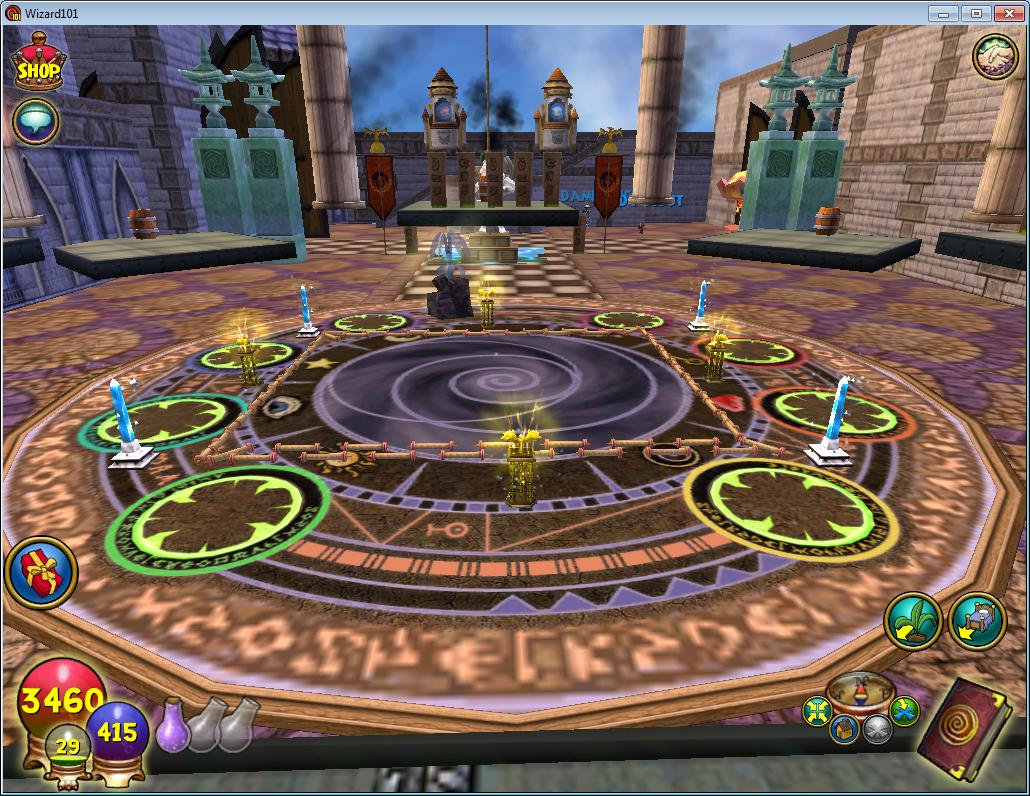
Out from the lava of February comes a bustling explosion of human design and creations.  While Cassandra Hexthorn's MFP design was focused on the darker side of man's inventions, I contrasted with the appreciation for culture and innovation.  Welcome to "The Globe."
What humans have imagined and designed has always fascinated me.  I mean, take a look at Wizard101, and  then try to convince me that Homo sapiens aren't fascinating and clever.  This product is an example of our (again, that word...) culture.  References to movies, music, philosophy, history, games, books, and values passed down through the generations exist in these files -- records of our creativity, in other words.


Smoking columns float along with Mooshian flags to signify an active dueling grounds.  
The items within here have a theme that blend Mother Nature and mankind together.  Stone columns were crafted out of rocks by humans.  The barrel in this picture was formerly a tree that was cut down and sent to a lumber mill for carpentry.  Wooden boards with cryptic writing display our unique ability to communicate through systematic languages.

Scrolls and trophies surround the casting field.
Due to the high frequency of spectators and duelers asking other players to remove themselves from the center of the dueling circle, I began to hone my floating techniques into designing some kind of "barrier" that would (1) prevent others from trespassing through, but (2) allow visibility for both the audience and participants alike and (3) allow accessibility for potential participants (i.e. allow people to join the battle circle after a duel has ended).  I ended up creating a video on how to float items into the PVP ring.  Trophies were placed along the barrier of scrolls to give it a more aesthetic feel.

Minigames and wooden boards above the seating platforms.
There were a few hilarious glitches to the design itself...one being that if a player ran directly below a minigame kiosk that was situated on a raised platform, that player would find themselves encased within the kiosk!  The columns were also floated to ensure that visitors could traverse the area without the inconvenience of collision.  These were all late revisions to, again, enhance user-friendliness.  The wooden boards also serve a very special purpose:

The view from riding a mount and wearing a Life Amulet.
One pet peeve that I have with Wizard101 is the lack of the ability to zoom your camera in for a first-person view; your wizard's always in the way!  However, you can force the camera to zoom further in, simply by placing your character's back to a wall, and looking straight ahead, as demonstrated in the picture above.


A first-person view, without the mount, weapon, or amulet.
Five boards were placed on platforms that were perpendicular to one another to allow spectators the freedom of watching a match without their body obstructing some of the view.  With a raised view, they also provide for some awesome visibility all around.  Here are some other views from the other platforms:

"South" view

"East" view

"North" view
One guess I could make about why I become so excited about designing an arena ring:  Wizard101 is on the focus of plot development through a series of card battles.  Your wizard develops a reputation with the teachers after completing quests and defeating monsters and bosses with the use of cards.  Word of mouth, supposedly, brings your name to other characters and other worlds, and eventually you become an influence to their world or their culture.  Purses are returned to their original owners because you pulled out a blade or a trap card.  Thus, to me, what appeals the most is where you're using the cards.  The team positions, cards, decks, weapons, and pets may all look the same, but there's a noticeable change in what you feel when your battle takes place in a strange or unfamiliar area.  You're either excited, intimidated, distracted, or visually stimulated in some way, shape, or form.

So, welcome to yet another personal Battleblood project: Arena Design, where ideas and plans are executed, floating and housing mechanics are dissected, and other works within the community are appreciated.

Friday, July 1, 2011

Into the Spiral: Issues At Home and Abroad

Before picking up my Arena deck and heading into the duelists' lobby this weekend, there are some important PVP-related matters that I must address.  The first has been suspended in thought, probed thoroughly during my contemplative moments.  The latter is a separate problem, originally unrelated.  That is, it was, until the connection of these vertices (and all dots in between) became necessary for a solid point that needs to be made and touched on.  This point in question has become misrepresented and taken out of context recently, and while I introduce a personal and global issue, I hope to reconnect the dots to present the bigger, underlying picture.

Through countless observations of public reception, letters, and conversations inside and outside the Spiral, it seems that there are many players who misunderstand Perfect Catch, my PVP team.  Younger players look up to us as this "iron wall."  Our peers have jokingly and seriously viewed us as "unstoppable."  Almost every three or four days, I find a message in my inbox from some individuals, asking to challenge or fight Perfect Catch; most of these usually begin or end with some form of the statement of "I think we can beat you," where some are more or less troll-like.  Over the course of many months since the team's creation, we've had a pretty decent win-to-loss ratio, as evident with our videos on YouTube, but, inevitably, the illusion of us being unbeatable seemed to form somewhere within our audience.  We're perceived to be the "best" or "invincible."  As the leader and creator of the team, let me just say this:  "That's nonsense."

The fact of the matter is: we're just different.  Here's a great, hefty explanation here.  We're simply not the "best" out there (nor should any team be considered the "best," as an important side note), and we're obviously not invincible.  The key word here is "unique."  Teams may mimic or play in similar ways as us, but our strategies and thought processes are simply "outside of the box."  Guides cannot be written with specificity to what cards should be in decks because of our practice of adaptation and evolution; our cards (and ultimately, our decks) change every single game, much like how we play.  As explained in the Perfect Catch's Origin video, we try to be as flexible as possible so that we narrow down and shift around our weak point(s). 

We can't tell anyone how they should build their entire deck, though we can share the basics.  In fact, our cards (the 400~ spells between us) are chosen to specially synchronize Cassandra, Fallon, Ronan, and me in a virtually seamless way; unless you have people who think and react the exact same way we do, our deck builds will not do anyone much good!  Keep in mind: I'm not saying we're better; we're just in a different playground. 

Thus, when players meet us in the arena and outwardly express their fear or anxiety by shouting non-sequitur like "We've lost" or "Oh no, it's TPC," we flinch or grimace; and, when players outwardly express their confidence and arrogance by shouting other non-sequitur like "You're gonna lose" or "These guys are bad," we flinch and grimace, too.  I just want to point out that getting beat by TPC should NOT be expected (everyone has a chance to win against us) and that beating us should NOT be celebrated (again, everyone has that chance -- there's nothing special in it).  Matches -- especially when it's just one -- should NOT be used as a measurement of skill via the end result.  Bad luck in the form of fizzling, lag, and poor probability rates (i.e.  drawing "wrong" cards, going second, etc.) can be major factors for just one match, and thus, one fight should NOT determine who is better than who.  Instead, the focus should be on the long run; ask yourselves, "Can we win against other teams doing what we did just now?" and "Can we win against this team again and again?"  Hence, we don't care too much for teams that believe they've found a way to "defeat" TPC (in fact, TPC enemies should be looking for a way to break our friendships and bonds with one another if they're looking for our expiration date).  To understand our point of view, imagine if some random person ran up to you and yelled, "I know how to beat Malcolm Thunderstrider, Jenny Longstockings, Sebastian Gutentaag, and Tiny."  Big deal!  How about outplaying every other team out there, too?  That’s a feat that certainly deserves some recognition and applause.

But, let's not take this out of context.  There's a titanic difference between outplaying and defeating teams with simple, imbalanced strategies:  the former allows for a "dance" to play out, where players exchange spells against each other, while the latter is like stealing all the Monopoly money and preventing any transactions of actual strategy from being applied for true entertainment value.  Some people have suggested that if players don't like an aspect of the game, then they should not dwell on it or care about it.  Unfortunately, that's the equivalent to saying, "Don't play Monopoly if you don't like people ruining the game."  Monopoly's entertainment value has no correlation to how a few people play.  In this case, situations in PVP should not be treated like an umbrella for all aspects of PVP.

In Wizard101, the imbalanced strategies have transitioned from Chain-Stunning (where victims are not allowed to play anything) to Blade-stacking (where 5-7 stacked blades can do at least 4,000 resisted damage in one turn) to Chain-Stunning again, and is currently set on Tempest-Spamming (very similar to Chain-Stunning, where the victims are destroyed before they can play a card). 

I'll give you a little personal spoiler, in case assumptions arise with this seemingly volatile subject:  TPC is already developing an effective counter for Tempest-Spamming; we started a week ago, the night after the recording of the match I've released exclusively over Twitter.  It's working pretty well on our prototype pig, so the method (the "strategy" of Tempest-Spamming) is NOT what bothers us.  Period.

Instead, it's the social and technical effects that imbalanced strategies have on players and the community – that’s what bothers us.  Naturally, players tend to mistakenly treat a single win or loss as a measurement of skill or dominance.  “I’ve lost, so they’re better than me.”  That’s a dangerous fallacy to hold onto, because it enables cheap-tactic users to believe that they are a legitimately dominant force.  What’s the danger in that?

First, it discourages newer players or Arena participants from appreciating the true nature of PVP.  Just last night, someone on Twitter asked how PVP was appealing at all if there were so many concerns about imbalanced strategies.  The thing is, imbalanced strategies do not affect us or other advanced teams personally, but the internal aspects do tend to harm the naïve who use them.  These infamous playstyles require little thought, preparation, and coordination.  Accepting them as a legitimate norm would be misrepresenting what PVP is truly about: advanced play.  Most people PVP because they enjoy playing against human intelligence, rather than against a monster that exhibits boring patterns and incompetence.  It’s a totally different element when your enemies have the capability to anticipate and plan.  So, when cheap tactics are used (playing as if it’s a farm run rather than playing against humans), the lack of advanced play creates the illusion that PVP is generally about killing rather than outplaying.  Sounds like more grinding, honestly.

Secondly, to an audience of players who enjoy and understand what PVP is all about, imbalanced strategies are like trumpets calling out for verbal attacks, disapproval, and negative association.  Skilled players, with all their knowledge, wisdom, and experience, take appreciation in participating in the “dance” known as a “duel,” where an exchange of tactics fly from circle to circle.  Imbalanced strategies hinder and cut off that dance.  Imagine taking a salsa class, only to end up failing the course because the judges flipped a coin and determined they would grade you based on how it landed; you never got the chance to perform.  I don’t think anyone would just sit back and accept their fate silently, in that case.  Thus, cheap tactics create social pressure and tension.

Third, those who utilize such methods tend to stunt their ability to advance further in Rank once a direct or indirect counter is found.  Think of the Fisherman Metaphor.  “If you give a man a fish, he will last for a week.  If you teach that man how to fish, he will last for a lifetime.”  By letting imbalanced strategies exist as accepted styles of team play, the pool of incompetent players increases, and as a result, their reliance on a single tactic will require them to take advantage of lower ranks (via down-ranking).  Because there is no self-development available for using notorious plays, there is little room for change, innovation, and reform.  Therefore, when a team like TPC comes along and finds a way to counter (for example) Blade-stacking, some teams have dropped out of the Arena due to the inexperience of playing another way.  Once something “stops working” the way it used to, its overall longevity is truncated; in this case, when a cheap tactic “stops working,” the user’s PVP participation dies (or slows), too.

So, why is understanding TPC and understanding the nature of imbalanced strategies significant or important?

Most recently, words and actions of my teammates over Twitter were taken way out of context, to the point where the original issue was no longer addressed.  Well, how do we put things into context?  By exploring three important components: community history, culture, and the full story.   Don’t want to hear it?  Well, consider the argument against California’s Three Strikes’ Law, where opponents of this law took it out of context by pointing out that it was putting away people for 25 years-to-life for petty acts such as stealing a pizza.  Sure, it sounds absurd, but when you take it back into context, realize that stealing the pizza was the third act in a series of law-breaking (including felonies).  By absorbing and opening yourself to more information, the situation becomes clearer and more justified.

TPC’s mission, since birth, is aimed to restore the fun to PVP by showing (1) teams don’t have to play a certain way to reach Warlord, (2) teams don’t have to follow a specific roster of school combinations, and (3) friends can PVP together, regardless of how much experience each of them have.  Ever since Ronan Dawn and I met for the first time, we’ve noticed that PVP had dwindling popularity and players were losing interest.  Left and right, PVP players were being judged in a lump sum, and we were deemed to be arrogant, selfish, obnoxious, or rude, just because we enjoyed that part of the game; no one believed that good sportsmanship existed in this realm.  Imbalanced strategies at the time, which was solely Chain-Stunning, created the illusion of “power.”  Friends of these teams rooted and cheered for their mates, while they spat and put down the unprepared victims.  Pretty similar to kicking someone down and making fun of them for being pinned.  Even 1v1 had its own trolls (and Gobblers, Onis, etc.)

Ronan and I knew we needed to shine the light on the other side of PVP, despite how difficult it was to make a case with all the unsportsmanlike conduct flying around in the Arena.  We just didn’t have a shared execution, nor did we develop one together.  But, we did agree that we needed to increase PVP’s popularity to add to the pool of players.  When the number of competitors grow, the number of inventions and strategies do as well.  It’s all explained here.

After TPC was created for the intent of friends having fun together, we realized that our peers around us didn’t agree or approve that we were moving from PVE to PVP.  Slowly, we took on active movements to reinstate the Arena’s good name through my Arena series, the PVP Party Forum, and PVP commentaries.

Thankfully, the Massive Fantasy Palace came out.  This enabled us to hold PVP Parties, where we encouraged players to renew their interest in the Arena by providing them an in-game site to innovate, test, individually measure their improvement, learn, and enjoy PVP, while discouraging and removing the badly behaved and bad sports.  Through this, the overall acceptance of PVP (from the Ravenwood Radio, Blogger, Twizard, and Diary of a Wizard end) increased tremendously.  Even our dear Paige Moonshade, who used to detest, dislike, and avert away from PVP after witnessing corruption amongst her friends in the past, rediscovered enjoyment in participation – she eventually overcame the dreaded anxiety, pressure, and tension she used to feel.

As you can see from my Arena series, it meant a lot for me if someone saw the light and benefits of PVP.  Paige and I had about two or three discussions last year, and I remember I was begging the question of whether or not she’d give PVP a chance again; she’d reply along the lines of “Never.”  But, as evident from the 2nd Annual Ravenwood Ball, that "never" wasn’t a promise, and I’m honored and happy that “the spell was broken.”  Paige is having fun again…and if you knew the Paige Moonshade from many months ago, you’d see this as some sort of miracle, too.  Cassandra Dragonheart was also a relatively new PVP prospect around the time – initially, she didn’t see or believe much in PVP (due to the negative environment and bad sportsmanship of other wizards).   It took time, and I’m glad she gave it a chance, because now she’s fighting around the 1300+ ranks and enjoying a new hobby.  Our very own Autumn Duskhunter from Homework in a Graveyard (a non-regular PvPer), after attending one of our parties, developed enough interest to stand around for a number of TPC Ranked matches,  ask for tips and tricks, and apply them.  Many people from Diary of a Wizard and YouTube thanked us for relighting their Arena candle.  

Each member of TPC is a strong advocate for being supportive and constructive for a player’s PVP development.  In other words, we’re critical of other players who accept, condone, or promote the methods that accelerated the Arena into the Dark Ages.  We don’t believe that the use of imbalanced strategies is ever a positive or constructive way to improve one self, or accurately represent what PVP really is about.

A few nights ago, there was a disturbance in our attempt to keep the PVP environment harmonious.  An imbalanced strategy, mainly Tempest-Spamming, was used by one of our regular PVP Party participants.  Don’t get me wrong, now – that wasn’t the main issue.  Instead, the problem was that a few players were teaching a young child that the imbalanced strategy was an acceptable learning tool for their PVP development.  When my teammates questioned their logic, one replied that “they will learn the hard way.”  Keep in mind that this is an adult encouraging a younger player to put himself (or herself) into a volatile situation, considering the three negative aspects of imbalanced teams explored above.  The counter-argument was that the child was going to be subject to insults anyway.  This is what threw some of us off.

Even when teams like TPC play fairly, it’s true that we’re still on the receiving end of insults and profanity.  This is from a default player base that will always exist, called “trolls,” which are players who have nothing but destructive comments, motives, and intentions, where their actions do not benefit or help anyone but themselves.  When players win or lose against trolls, it’s generally expected that there will be something said from the other side that doesn’t help anyone improve or leave dignified.

Thus, it seems cruel, if not negligent, to encourage a younger player to adapt a playstyle that will add another player base to sink the child down further into social and emotional pressure.  This player base is generally of the rest of the PVP community, where players play to have fun or improve their skills in the game.  When Tempest-Spammed, the fun is ruined for these players who want to give the Arena a fair chance and who want to learn and enjoy the game.  

My question is, why not advocate for the child to play in a productive way, so that, instead of the burden of negative recognition, they are known positively?  On top of peer pressure and the innate desire to want to belong, children do not need another reason for other players to talk down to them.  Blade-stacking, chain-stunning, and Tempest-spamming may earn them some easy rank points and tickets, but PVP will lose its fun if the player (1) is constantly bashed and flamed, (2) realizes that a game update will quench their winning streak, (3) sees everyone else rooting for the other side, (4) becomes bored with the repetitive playstyle, (5) loses friends and gains enemies, (6) and/or runs into a counter.  Teach them how to PVP, and they will find windows upon windows of opportunity to improve.  Also, if they are respected, they may find their own self-respect, opposed to degenerating out of spite.

It’s understood that Twitter recently exploded with a lot of misconceptions as the issue was taken so heavily out of context that most Twizards failed to learn of the actual problem.  Instead, it sounded as if small battles were trying to be won through blunt, singular points that did not contribute to solving the actual problem.  The wrong people were being called “trolls.”  Players of skill were being told to discontinue their hobby if others used cheap tactics to win.  Active, trusted, and credible community members did not have their voices heard.  I originally wanted to discuss and defend these issues, but I think most of them will be spoken for in the near future.  Those of you who’ve made it this far into reading and understanding (some friends and I thank you, deeply) will see what I mean...for example, sharing the counter against Tempest-Spammers, debunking the idea that TPC and friends were "complainers."

Before making judgments based off of actions, get to know each person involved and get to know the issue at hand.  Take into account all stories, not just one, lest there comes another monumental misunderstanding within our community.  Self-victimization is not a long-term buoyant.  If involved in a conflict, understand that within due time, when all these multiple stories and puzzle pieces have aligned, the act of gambling a friend's alliance and omitting key information will come back to bite someone in the end.  When you write, voice, work, play, or act with a positive and constructive attitude, and maintain integrity, we all win.

Thank you for your time.

Monday, May 23, 2011

Vlog #14: Summer Battleblood Updates and News (5/23/11)

Topics: Blogging/Vlogging, PVP Videos/Commentary, secret projects, self-improvement, and a future "offer" from TPC.


Vlog #13: Saturday's PVP Workshop

Topics:  How PVP has changed since Wintertusk's arrival, and an analytical review of  the new spells!